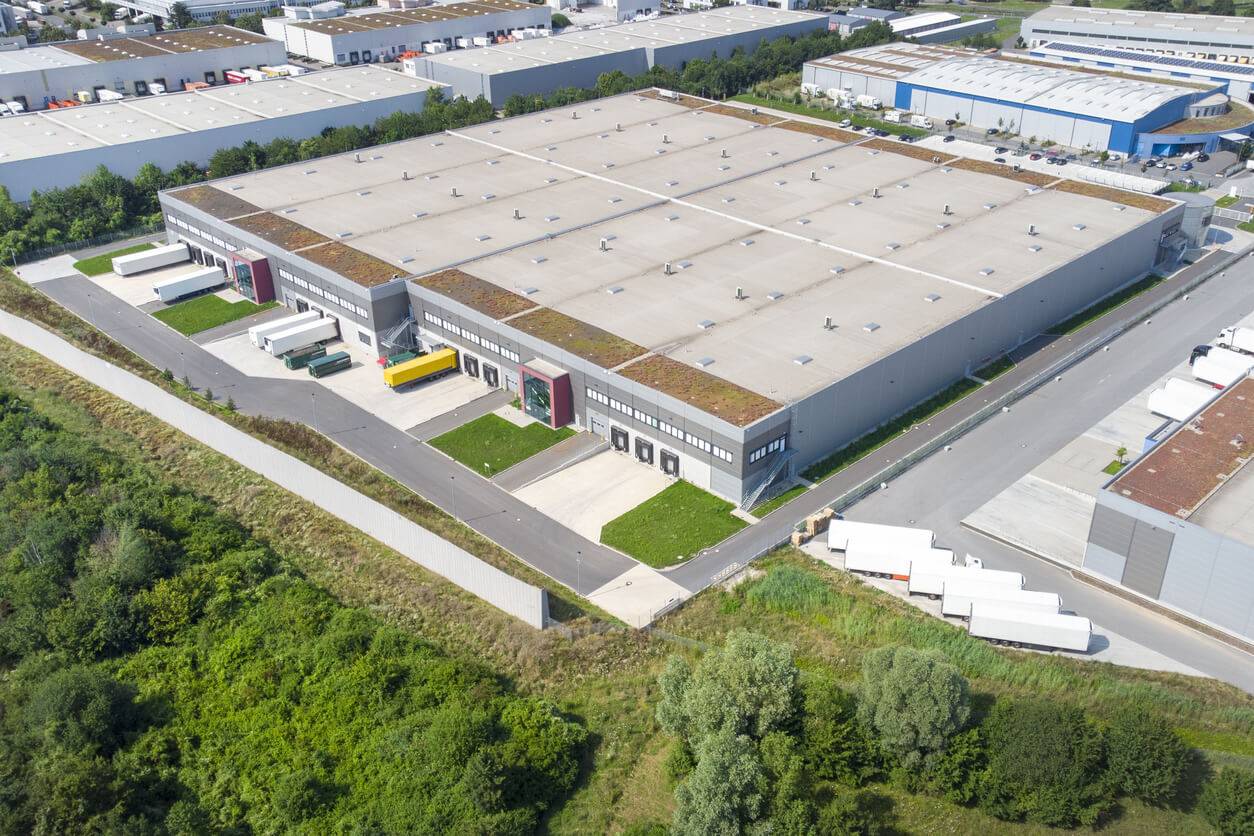
The Inland Empire has become the logistics capital of the world. The concentration of warehouse and distribution space in the Riverside-San Bernardino metropolitan area is the largest on the planet: hundreds of millions of square feet of industrial buildings, rooted in the I-10, I-15, and SR-60 freeway corridors and served by Ontario International Airport, one of the fastest-growing cargo airports in the United States. Amazon, Walmart, Target, and virtually every major e-commerce and retail logistics operation in North America has a major distribution center footprint in this market. The roofing demands of this scale of industrial development are extraordinary, and the Inland Empire's extreme climate, temperatures above 110°F, intense UV, minimal rainfall, and no freeze, creates specific technical requirements that set this market apart from industrial roofing anywhere else in the country.
Ontario International Airport has grown into one of the most strategically important cargo gateways in the western United States, with cargo volume growing faster than any other major US airport as shippers redirect freight from the congested Los Angeles basin. The airport's cargo handling facilities, freight forwarder warehouses, and cold-chain logistics buildings operate continuously and cannot accommodate roofing-related operational disruptions. Airport-adjacent roofing work requires coordination with airport operations for access, compliance with airfield safety requirements, and careful management of materials and equipment near active taxiways and cargo aprons. Our team has experience working in airport environments and understands these requirements.
March Air Reserve Base and its associated industrial development add a defense dimension to the Riverside County industrial roofing market. The former military base has been converted to a civilian joint-use airport with substantial industrial and warehouse development on its former military land holdings. These large industrial parcels house distribution, manufacturing, and logistics operations that benefit from the freeway access and logistics connectivity of the March area. Work in this environment requires familiarity with the joint-use airport operational protocols and the security considerations of the continuing military presence at the installation.
San Bernardino International Airport represents another emerging logistics hub in the Inland Empire's east end. Former Norton Air Force Base has been redeveloped as a cargo-focused airport serving the I-10 east corridor, with industrial development clustered in the surrounding communities of San Bernardino, Loma Linda, and Colton. The roofing demands here are similar to the broader Inland Empire market: extreme heat, intense UV, minimal rainfall, and large building footprints requiring meticulous drainage engineering for the occasional but intense rainfall events that California's periodic atmospheric rivers deliver.
Extreme heat is the defining roofing challenge in the Inland Empire. Summer temperatures regularly exceed 110°F, and rooftop membrane surface temperatures on dark or low-reflectivity roofs can reach 180°F or above. No standard roofing membrane is designed to perform at these surface temperatures without degradation over time. White and highly reflective membranes reduce surface temperatures by 40 to 60 degrees compared to darker alternatives, which dramatically extends membrane service life, reduces cooling loads on the massive air-conditioned distribution centers in this market, and may satisfy California's Title 24 cool roof requirements. We specify only white or near-white TPO and PVC membranes for Inland Empire industrial applications: the performance and energy benefits are too significant to justify anything else.
UV radiation in the Inland Empire is among the highest in North America. The combination of Southern California's high solar elevation angle, minimal cloud cover, and the reflective surface environment of an urbanized desert valley creates UV intensity that degrades standard roofing materials faster than manufacturers' warranty projections: which are typically based on more moderate conditions. We specify membranes with documented UV stability at high-intensity conditions, and we use fluoropolymer-coated metal products and UV-stabilized sealants for all metal roofing and flashing applications. Membrane thickness is also important in high-UV markets: 60-mil membranes provide a meaningful service life advantage over 45-mil products when UV degradation is the primary aging mechanism.
The massive scale of Inland Empire distribution centers creates drainage engineering challenges that are unique to this market. Warehouse buildings of 1 million square feet or more have enormous roof drainage demands: even the region's modest average annual rainfall of 10 inches, when it falls in a single atmospheric river event, can produce enormous volumes of runoff from a roof field this size. Interior drain systems on buildings this large must be carefully engineered with adequate drain capacity and positively sloped roof fields to ensure rapid water removal. We design drainage systems for large-format Inland Empire distribution centers using local intensity-duration-frequency data from the 100-year storm event and require secondary overflow protection at every primary drain location.
Thermal cycling in the Inland Empire creates a specific pattern of membrane and attachment stress. Daily temperature swings of 40 to 50 degrees are common from summer to winter, and the Inland Empire's geography, sitting in a valley between mountain ranges, creates local temperature extremes that can be 10 to 15 degrees warmer than coastal Southern California. This daily expansion and contraction stresses mechanical attachment points and seam adhesive bonds over time. We use heavier fastener patterns, wider seam widths, and heat-welded seam construction on mechanically attached systems to provide the fatigue resistance this thermal cycling demands. Fully adhered systems, where substrate conditions allow, eliminate fastener stress points entirely and provide superior wind uplift resistance.
California's Title 24 energy code imposes specific cool roof requirements on large commercial and industrial buildings that have become more stringent in recent code cycles. The Inland Empire's extreme heat climate creates both the greatest compliance requirement and the greatest energy benefit from cool roof systems: the reduction in cooling loads from a properly specified reflective roofing system on a large distribution center in this market can save tens of thousands of dollars per year in electricity costs. We provide Title 24 compliance documentation for every commercial roofing project in California, using CRRC-listed products with verified solar reflectance and thermal emittance values.
The Inland Empire's industrial roofing market is enormous in scale and demanding in technical requirements, and it rewards contractors who invest in the expertise to navigate its specific climate, regulatory, and operational challenges. Our team holds California C-39 roofing contractor licensing, manufacturer certifications for the major membrane systems used in Inland Empire industrial applications, and the project management capabilities to handle the large-scale, time-sensitive roofing projects that characterize this market. Whether your facility is a multi-million-square-foot distribution center in Rialto, a cargo handling facility at Ontario Airport, or a manufacturing plant in the Corona industrial corridor, we deliver industrial roofing solutions built for the specific demands of Southern California's extreme environment.
Questions Owners Ask
What membrane color and type should I specify for my Inland Empire distribution center?
For low-slope industrial buildings in the Inland Empire, white or near-white TPO or PVC membranes are the strongly preferred specification. White TPO with a solar reflectance of 0.70 or higher reduces membrane surface temperatures by 40 to 60 degrees compared to gray or tan alternatives, which dramatically extends service life in this extreme UV and heat environment. White membranes also satisfy California Title 24 cool roof requirements, which mandate minimum solar reflectance values for most commercial and industrial roofing in California. For a large distribution center, the energy savings from reduced cooling loads provided by a reflective membrane are substantial: often $30,000 to $100,000 per year or more depending on building size and occupancy hours.
How do California's Title 24 cool roof requirements affect my industrial roofing project?
California's Title 24 Building Energy Standards require low-slope commercial and industrial roofing systems to meet minimum solar reflectance and thermal emittance values, which vary by climate zone. The Inland Empire's climate zones (typically CEC Climate Zone 10 or 13) have some of the most demanding cool roof requirements in the state, reflecting the extreme summer heat and high cooling energy demand of the region. Compliance requires specifying products listed on the CRRC (Cool Roof Rating Council) product directory with verified performance values, and documenting compliance on the CF1R or CF2R forms submitted with the building permit application. White TPO and PVC membranes routinely exceed these requirements, making compliance straightforward on most new installation and re-roofing projects.
How do I manage drainage on a 500,000+ square foot distribution center roof in Inland Empire?
Large distribution center drainage requires a systematic engineering approach that accounts for the full range of storm intensities in the local climate, not just average annual conditions. We size drain spacing and drain capacity using the local 100-year storm event intensity from IDF curves published by the relevant county flood control district, which in the Inland Empire reflects both normal Southern California rainfall and the intense atmospheric river events that periodically deliver several inches in 24 to 48 hours. Interior drains on large buildings are spaced to serve roof areas within established hydraulic limits, and secondary overflow scuppers are required at every primary drain to provide independent drainage capacity in case primary drains are blocked. Slope to drain, minimum 1/4 inch per foot throughout the field, is non-negotiable on large flat-roof buildings.
What are the wind uplift requirements for Inland Empire industrial buildings?
The Inland Empire is subject to the Santa Ana wind events that periodically affect Southern California, producing sustained wind speeds and gusts that can significantly exceed the standard design wind speeds used in building codes. For industrial roofing, we recommend designing to at least FM 1-90 wind uplift standards and providing enhanced fastening density at perimeter and corner zones regardless of whether the specific code calculation requires it. Santa Ana winds, which blow from the northeast, opposite to the prevailing wind direction, can apply wind pressure to building faces that standard analysis may not fully account for. Edge metal attachment is particularly important in this wind regime: properly secured and adequately heavy edge metal systems are the first line of defense against wind uplift events that start at the perimeter.
Can I extend the life of my existing Inland Empire industrial roof with a coating?
Yes, silicone coating is an excellent restoration strategy for aging roofs in the Inland Empire, provided the existing insulation is dry and the membrane is structurally sound. Silicone outperforms acrylic coating in the Inland Empire's high-UV, high-heat environment: acrylic coatings can soften and blister at the surface temperatures that Inland Empire roofs reach in summer, while silicone maintains its properties through extreme temperature ranges. A properly applied silicone restoration coating adds 10 to 15 years of service life, restores solar reflectance to near-new levels (reducing cooling loads), and provides seamless waterproofing over the complex penetration fields common on large distribution center roofs. The critical prerequisite is an infrared moisture survey confirming no wet insulation: we will not proceed with coating restoration without this confirmation.