
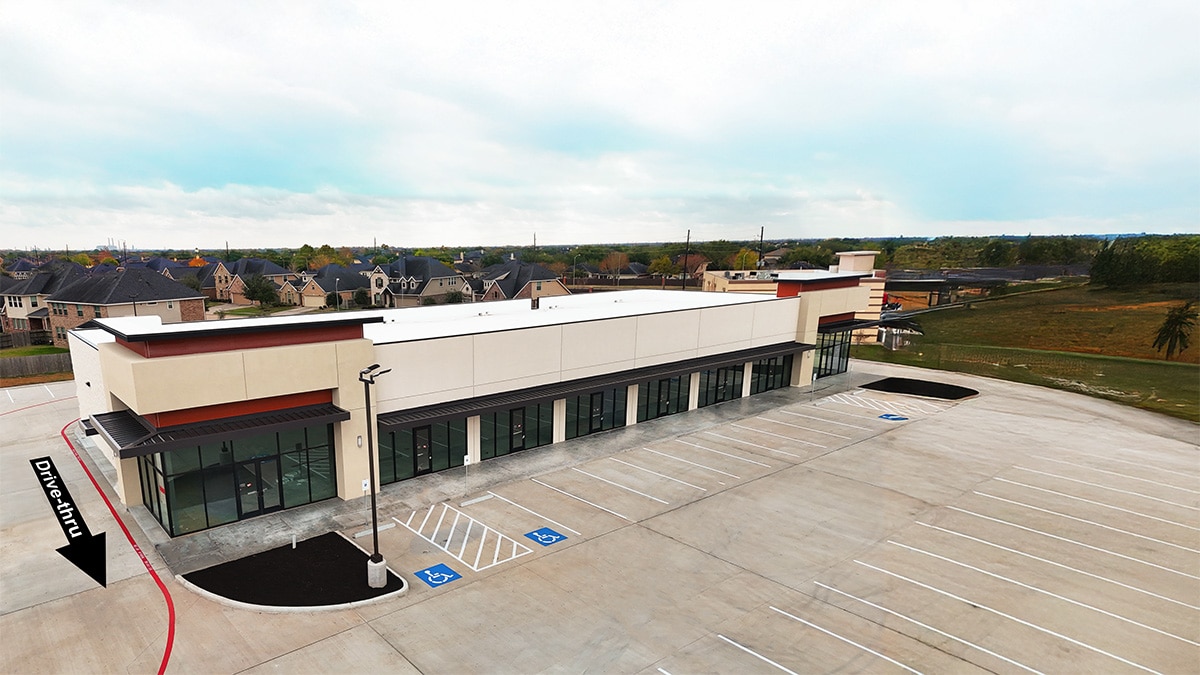
Riverside's retail real estate market reflects the Inland Empire's dual identity as both a logistics and distribution hub and a rapidly growing neighborhood and commercial center. The retail corridors along Magnolia Avenue, the shopping centers driven by major grocers in Moreno Valley and Corona, and the power centers near the 60 and 91 freeways serve one of Southern California's fastest-growing consumer populations. Roofing for these retail properties operates in a climate that is harsher than coastal LA or San Diego: Riverside sits in a valley that concentrates summer heat, reaching 105°F or more on peak July days, while also receiving occasional winter rain events and the Santa Ana wind conditions that drive fire risk and create extreme roof uplift loads during seasonal wind events.
TPO membranes are the standard specification for Riverside area retail roofing, with reflectivity being the primary driver. Rooftop surface temperatures on dark or aged membranes in Riverside summer conditions regularly exceed 180°F, creating thermal loads that accelerate HVAC compressor wear, increase tenant cooling costs under gross or modified gross lease structures, and degrade the membrane itself from the heat cycling. A white 60-mil TPO system on an adequately drained Riverside retail roof can reduce rooftop temperatures by 70 or more degrees and materially extend the service life of the equipment sitting on it. For strip mall landlords managing multiple HVAC units across multiple tenant bays, that equipment protection argument is compelling.
Santa Ana wind events represent the most acute weather risk for Riverside retail roofs and require specific attention in any roofing specification. These seasonal offshore wind events generate sustained speeds of 40–60 mph with gusts well above that, and they can arrive with almost no warning during fall and early winter months. Inadequately attached edge metal, fascia, coping, and termination bar, is the most common failure mode during Santa Ana events, and once edge metal lifts, the field of the membrane typically follows. ANSI/SPRI ES-1 compliant edge metal with properly engineered fastener patterns and cleated joints is mandatory on any Riverside retail roof expected to perform through its full service life.
HVAC penetration management on Riverside retail properties has a desert dimension: dust accumulation. The Inland Empire's air quality challenges, including the particulate load associated with nearby agricultural operations and the semi-arid environment, means that HVAC units on retail rooftops accumulate debris faster than in coastal markets. Filter replacement cycles are shorter, unit access requirements are higher, and rooftop surfaces see more foot traffic from maintenance personnel as a result. HVAC access pathways should be specifically designed into any retail roofing project: walk pads from the roof access hatch to each major unit cluster, properly detailed to avoid creating low points where water collects.
Drainage design for Riverside retail roofs must account for the intensity of the occasional winter rain events that the Inland Empire receives. While annual rainfall is modest by national standards, Riverside averages around 11 inches per year, when rain comes, it often comes in concentrated multi-inch events driven by atmospheric river conditions. Flat retail roofs with marginal drainage capacity handle routine light rainfall adequately but can be overwhelmed by an atmospheric river event that drops 3–4 inches in 24 hours. Proper scupper sizing based on the local 100-year rainfall intensity, not just average annual rainfall, is the correct engineering basis for Riverside retail drainage design.
The strip malls along Magnolia Avenue and the older commercial corridors on Arlington Avenue and Chicago Avenue include retail buildings constructed in the 1960s, 1970s, and 1980s that have accumulated roofing layers and deferred maintenance over decades. These properties are common investment acquisition targets because they can be purchased below replacement cost, but the roofing on many of them is at or past end of life. A buyer acquiring a Riverside strip mall on the basis of current NOI needs to accurately underwrite the roofing capital event: a building with a roof that needs replacement within two years has a different effective purchase price than the asking price implies, and professional condition assessment prior to closing is the only reliable way to quantify that difference.
Retail tenant coordination in Riverside requires sensitivity to the market's strong independent business community alongside the national chains that anchor larger centers near the freeways. The family-operated retailers, Mexican restaurants, auto parts stores, beauty supply shops, and the multi-generational businesses that are the backbone of Riverside's neighborhood commercial strips, operate on margins where a week of disrupted access to their storefront is a genuine financial hardship. Contractor scheduling that genuinely minimizes the access disruption window, rather than managing it as a formality, matters to these operators in a way that feeds directly into long-term landlord-tenant relationships.
CAM budget management for Riverside retail is shaped by the California commercial real estate environment, which tends toward detailed lease language and sophisticated tenant representation even for mid-size strip centers. NNN leases are common, but the specific recovery provisions vary significantly from deal to deal. Some Riverside retail leases cap CAM increases or exclude capital improvements from recovery, making it essential for landlords to understand exactly which roofing costs are recoverable before committing to a project budget. Property managers who maintain detailed documentation of all roofing maintenance activity, inspections, repairs, maintenance contracts, are best positioned to defend CAM reconciliation entries when tenants audit.
The right commercial roofing contractor for a Riverside retail project combines Inland Empire climate knowledge, understanding Santa Ana wind exposure, summer heat intensity, and the specific atmospheric river drainage scenarios, with genuine multi-tenant retail project experience. Southern California has no shortage of commercial roofing contractors, but the subset with documented strip mall and shopping center experience in the Riverside-San Bernardino market, verified manufacturer certification status, and the project management infrastructure to coordinate with multiple tenants simultaneously is considerably smaller. Reference checks from property managers who oversaw comparable projects in the IE are the most reliable vetting tool available.
- How should a Riverside retail roof be designed to handle Santa Ana wind events?
- Edge metal, fascia, coping cap, and termination bar, must meet ANSI/SPRI ES-1 standards with engineered fastener patterns and cleated joints, because the edge is consistently the first failure point in high-wind events. Field membrane attachment should meet FM 1-90 uplift rating minimum, with higher ratings appropriate for buildings at exposed locations near freeway corridors or hillside areas where wind channeling amplifies local speeds. Contractor verification that installed assemblies match the specified uplift rating is a required project closeout step.
- Why do Riverside retail properties need specific walk pad design for HVAC access?
- The Inland Empire's dust load and heat stress accelerate HVAC maintenance requirements, meaning more foot traffic from technicians on the roof surface than in coastal markets. Walk pads create a defined pathway from the access hatch to each major HVAC cluster, protecting the membrane field from foot traffic damage and preventing membrane surface abrasion at points where technicians step directly off the pad. Improperly detailed walk pads create low points that hold water, so they must be sloped to drain or set at the membrane plane with proper perimeter detailing.
- How should Riverside retail investors evaluate roof condition during acquisition due diligence?
- A professional condition assessment prior to closing provides a documented membrane age, remaining service life estimate, and identified deferred maintenance items, all translated into a capital reserve requirement. For older Riverside strip centers where the roof may be at or past end of life, the assessment should include core cuts to verify deck condition and quantify any moisture-saturated insulation that needs replacement. An unquantified roof liability is one of the most common ways retail investors underestimate total acquisition cost in this market.
- What drainage standard should be used for Riverside retail roof design?
- The 100-year rainfall intensity for the Riverside area, not average annual rainfall, is the correct basis for sizing primary drains and overflow scuppers. Riverside's modest average annual precipitation is misleading because the region receives that rainfall in concentrated events driven by atmospheric river conditions, with single-day totals of 3–4 inches possible. Scuppers and internal drains sized for average conditions will be overwhelmed during peak events, creating ponding loads that stress both the membrane and the structural deck below.
- What makes TPO particularly advantageous for Riverside retail buildings compared to EPDM?
- EPDM's black or dark surface absorbs solar radiation and reaches much higher rooftop temperatures than white TPO, which is a critical disadvantage in Riverside's summer heat. TPO's heat-welded seams also outperform EPDM's adhesive-bonded lap joints in the extreme thermal cycling that Riverside experiences: large diurnal temperature swings stress seams repeatedly over the system's life. The combination of reflectivity and seam integrity makes TPO the more appropriate long-term choice for the Inland Empire's climate conditions.