
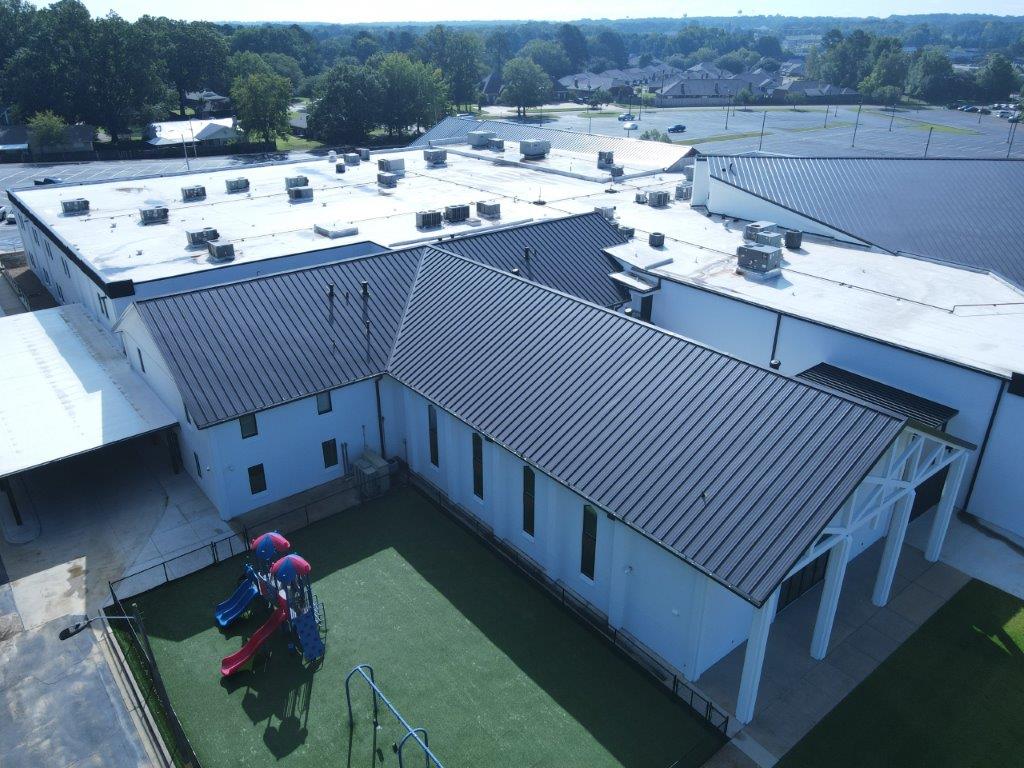
Magnolia Avenue Baptist Church, one of Riverside's largest and most active congregations, operates a multi-building campus in the heart of the Inland Empire that serves thousands of members across its worship, education, and community service programs. Riverside's position in Southern California's Inland Empire subjects church buildings to one of the most extreme UV and thermal environments in the country: more intense even than coastal Los Angeles, because the Inland Empire lacks the marine layer that moderates temperatures along the coast. Summer roof surface temperatures regularly exceed 185 to 200°F and annual UV dosage ranks among the highest in the continental United States.
UV degradation is the primary failure driver for roofing membranes in Riverside. Standard modified bitumen cap sheets that perform well in the Pacific Northwest or the Midwest for 20 to 25 years may show significant oxidation, granule loss, and surface cracking in Riverside within 10 to 14 years if not specified with UV-stable formulations and adequate reflective surfacing. Churches in the Inland Empire investing in major roofing projects should insist on 60-mil or 80-mil white TPO or PVC membranes with documented high Solar Reflectance Index ratings, or granulated modified bitumen systems with confirmed UV-stable formulations, and they should verify those claims with manufacturer technical data sheets, not just sales representations.
Thermal cycling in Riverside is a secondary but significant stress factor. The combination of extreme daytime heat and relatively cool desert nights creates a wide daily temperature swing: membrane surface temperatures can cycle 80 to 100°F between midnight low and midday high in summer. This diurnal cycling causes repeated expansion and contraction at every seam, flashing termination, and penetration detail. Properly heat-welded seams on single-ply systems and fully coated laps on modified bitumen systems are the details that withstand this cycling; sealant-dependent terminations that would hold for years in a moderate climate often fail within two to three years under Riverside's thermal stress.
Clear-span sanctuary roofs over Riverside's larger congregations are often steel-framed with metal deck, well-suited to mechanically fastened or fully adhered single-ply systems. The challenge in Riverside is ensuring that the insulation assembly below the membrane provides adequate thermal resistance, R-20 or higher, to slow heat gain into the conditioned space below while also reducing the diurnal temperature swing at the membrane surface itself. A poorly insulated roof assembly is not only an energy performance failure; it accelerates membrane aging by maximizing the thermal cycling stress at the membrane surface.
Capital campaign fundraising in Riverside's church community is often structured around spring giving cycles, with major commitments secured by April or May. This positions summer as the primary construction window: which, despite the extreme heat, is when most Riverside church roofing projects are best executed. Southern California's dry season from late spring through early fall eliminates rain risk entirely, allowing crews to work efficiently without weather delays. The key is selecting a contractor who implements rigorous heat illness prevention protocols: shaded break areas, mandatory hydration, pre-dawn start times, and wet bulb temperature monitoring.
Scheduling around church programming in Riverside's active congregations requires close coordination with church office staff from the first day of planning. Many Inland Empire churches operate robust weekday programs, food distribution, ESL classes, after-school programs, and twelve-step meetings, that cannot be suspended for a roofing project. An experienced contractor will designate a project superintendent who communicates daily with church staff, posts clear daily work area notices, and manages debris containment and temporary weather protection in a way that respects the congregation's ongoing ministry obligations.
California Title 24 energy standards apply to roofing work on church buildings in Riverside, and the cool-roof requirements specify minimum Solar Reflectance Index values for low-slope replacement projects. A contractor who is not current on California Title 24 requirements risks specifying a system that fails to comply, creating permitting complications or requiring specification changes after material procurement has already begun. Title 24 compliance should be confirmed in the specification before any contractor is invited to bid.
Seismic considerations, while more prominent for healthcare and hotel buildings in California, are relevant to large church roofing assemblies as well. Rooftop mechanical equipment, HVAC units, exhaust fans, and communications equipment, must be anchored to the roof structure with seismically rated curb connections and equipment restraints. A roofing contractor replacing or repairing curb flashings around rooftop equipment should verify that the underlying equipment anchorage meets current California Building Code seismic requirements and flag any deficiencies to the church's facilities team.
The Inland Empire's competitive roofing market means Riverside churches will generally receive multiple qualified bids for a well-specified project. Selecting the right contractor requires looking beyond price to assess the crew's specific experience with religious buildings, the contractor's history with California Title 24 compliance, the strength of the manufacturer relationships that enable warranty registration, and the project superintendent's communication track record on complex occupied-building projects. A church that invests the effort in a thorough contractor selection process will be rewarded with a roof system that outlasts the extreme Inland Empire climate for the full term of its intended service life.
- How quickly do roofs degrade in Riverside's climate compared to other cities?
- Roofing systems in Riverside's Inland Empire climate typically experience UV and thermal degradation at a rate roughly 30 to 50 percent faster than the same systems in moderate-climate markets like Seattle or Denver. This means a 20-year system in a standard market may deliver only 13 to 15 years of reliable service in Riverside if not specified with UV-stable, high-SRI materials. System selection and specification must account for this accelerated aging when evaluating life-cycle cost.
- What does California Title 24 require for church roof replacements in Riverside?
- California Title 24 Part 6 requires that low-slope roofing replacements on non-neighborhood buildings meet minimum aged Solar Reflectance and Thermal Emittance values, or achieve a minimum Solar Reflectance Index of 75 for aged performance. Your contractor's specification should cite the compliant product's Title 24 registration on the Cool Roof Rating Council database and address compliance in the building permit application.
- How do we protect our church roof from UV damage long-term?
- Annual inspections to check for membrane surface oxidation, granule loss, and seam integrity are the primary long-term UV protection strategy. Fluid-applied reflective coatings can extend the service life of aging membrane systems by renewing surface reflectivity and sealing minor surface cracks before they propagate. A proactive maintenance program documented by your contractor is the most cost-effective way to maximize the service life of any Riverside church roof investment.
- Can our roofing project qualify for California energy rebates?
- Southern California Edison and other California utilities periodically offer prescriptive or calculated energy efficiency rebates for cool-roof installations that exceed Title 24 minimum requirements. Check current program availability through the California Energy Commission's database of active utility programs before finalizing your project specification, and ask your contractor whether they have experience completing the documentation required for rebate qualification.
- What should our congregation do if our roof is approaching end of life in Riverside?
- Begin planning at least 18 months before the anticipated replacement need, allowing time for a formal facility assessment, capital campaign planning or financing evaluation, specification development, competitive bidding, and contractor selection. A roof that fails unexpectedly in Riverside's active church community creates emergency procurement pressure that limits competitive options and increases cost. Proactive planning is the congregation's best financial protection.