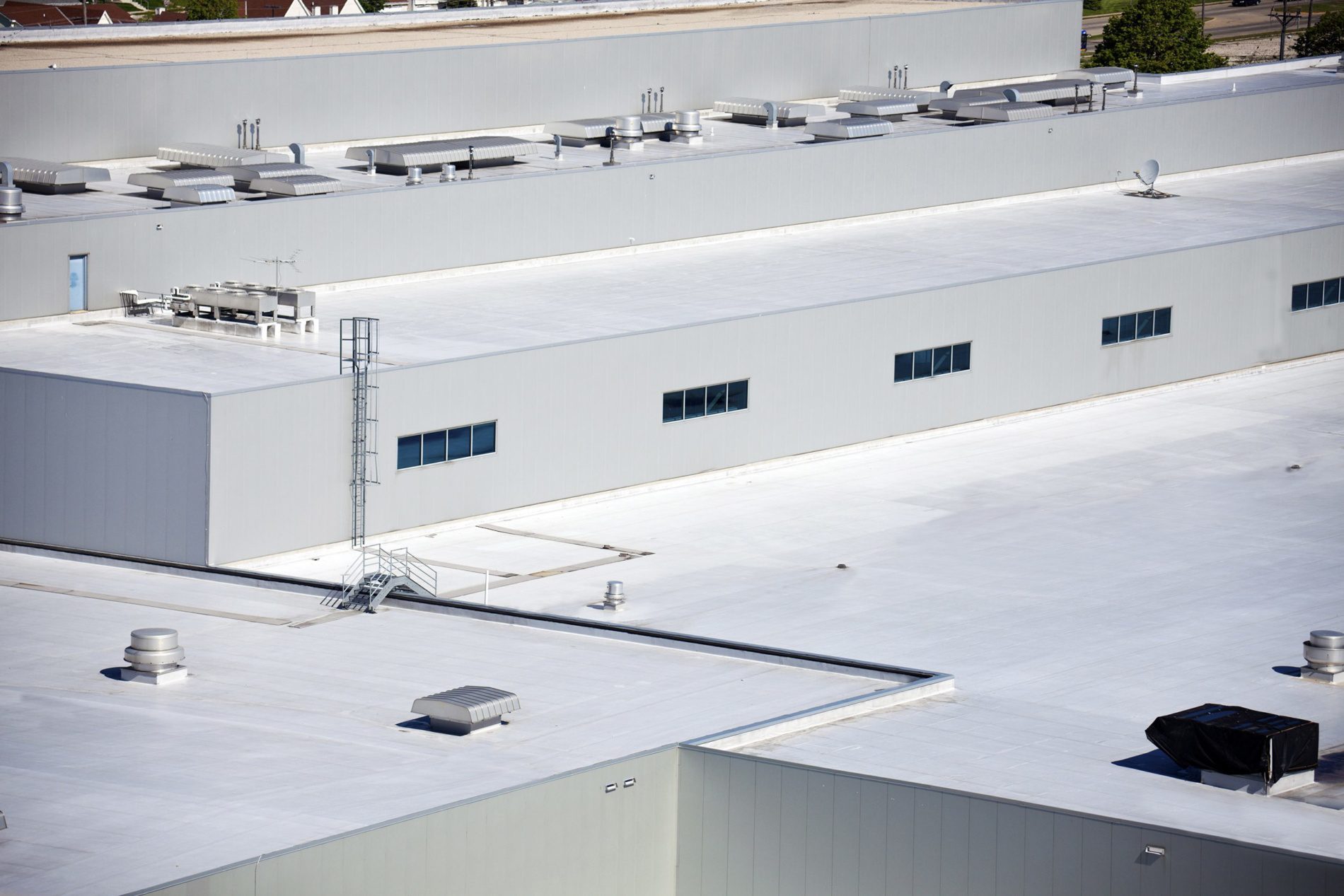
Riverside's Inland Empire manufacturing sector is one of the fastest-growing industrial hubs in California, with logistics-adjacent light manufacturing, food processing, and defense-related production facilities expanding rapidly along the I-215 and SR-60 corridors. March Air Reserve Base and the adjacent March Business Center host aerospace component manufacturers and defense contractors that represent the most technically demanding end of Riverside's industrial roofing market.
Aerospace component manufacturing generates metal chip, cutting fluid, and hydraulic oil vapors that migrate to rooftop surfaces through ventilation systems. Defense contractors operating precision machining centers and composite layup facilities use a range of process chemicals, including epoxy systems, paint solvents, and metal treatment compounds, that require roofing membranes with verified resistance to organic solvents. Sixty-mil TPO or EPDM fully adhered systems specified for the facility's actual process chemistry are the appropriate starting point for Riverside aerospace manufacturing roofs.
The Inland Empire's climate presents a thermal challenge that rivals any other California market. Riverside summer temperatures regularly exceed 105°F, and rooftop surfaces on low-slope industrial buildings reach 180–190°F without reflective protection. Dark or aged roofing membranes contribute directly to cooling loads in facilities that must maintain temperature-controlled manufacturing environments. California Title 24's cool-roof requirements mandate minimum solar reflectance and thermal emittance values for re-roofing projects on commercial and industrial buildings, and most Riverside manufacturers benefit from exceeding the code minimum to reduce utility costs further.
Vibration from Riverside manufacturing equipment, CNC machining centers, hydraulic presses, and conveyor systems, is moderate compared to heavy-steel environments but sufficient to cause fastener fatigue in mechanically attached roofing systems over time. Fully adhered systems are preferred for manufacturing floors, while mechanically attached systems may be acceptable in warehouse and storage areas with lower vibration profiles. The distinction matters for long-term maintenance cost: a fully adhered system that survives 20 years in a vibrating manufacturing environment costs less in total than a mechanically attached system requiring progressive fastener retrofit at year 10.
Skylights are common in Riverside's food processing and light manufacturing facilities, where natural light reduces artificial lighting energy consumption: a meaningful cost consideration given California's commercial electricity rates. Skylight curb flashings require annual inspection because Riverside's thermal cycling, hot days and significantly cooler nights even in summer, expands and contracts metal curb components repeatedly. Low-modulus sealants at skylight perimeter conditions, reapplied on a 7–10 year cycle, prevent the gradual joint opening that eventually allows water infiltration.
California's seismic environment shapes roofing system selection throughout Riverside County. The San Jacinto Fault Zone and the network of active faults crossing the Inland Empire create meaningful seismic exposure. Fully adhered membrane systems, which move with the building deck during seismic events, outperform mechanically attached systems in post-earthquake inspections. Penetration flashings should use flexible EPDM or TPO collar flashing rather than rigid metal where deck movement relative to penetrating pipes or equipment is possible.
Santa Ana wind events, typically occurring October through March, present severe wind uplift conditions across the Inland Empire. These offshore wind events can produce sustained gusts exceeding 70 mph on exposed industrial areas. Roofing systems on Riverside manufacturing facilities must meet California wind uplift requirements, and edge metal termination systems must be verified for both uplift and lateral (sliding) loads. Annual inspection of edge metal conditions before wind season is a critical maintenance practice.
California's environmental regulations add a layer of contractor qualification complexity for Riverside manufacturing site roofing. Work involving tear-off of existing roofing materials may trigger air quality management district requirements for dust and particulate control. Roofing contractors working on Riverside manufacturing sites should have current SCAQMD rule compliance procedures and documentation for tear-off projects.
Select a licensed California C-39 Roofing Contractor with manufacturer authorization for proposed systems, documented experience on Inland Empire industrial facilities, and familiarity with Title 24 cool-roof requirements and SCAQMD compliance for demolition and tear-off work.
- What Title 24 requirements apply to re-roofing a Riverside manufacturing facility?
- California Title 24 mandates minimum solar reflectance and thermal emittance values for low-slope commercial and industrial roofs. Current requirements for low-slope re-roofing specify a minimum 0.63 aged solar reflectance or a minimum solar reflectance index of 64. Most white TPO and EPDM products exceed these minimums.
- How should Riverside manufacturers address Santa Ana wind uplift risk on their roofs?
- Specify roofing systems with wind uplift ratings appropriate for the local wind speed zone, verify edge metal termination system uplift performance, and inspect edge conditions annually before October. Fully adhered membranes in field areas combined with mechanically fastened edge metal with verified withdrawal values address both uplift modes.
- What seismic roofing considerations apply in Riverside County?
- Fully adhered membrane systems are preferred for their seismic performance: they move with the deck rather than racking against fasteners. Penetration collars should be flexible EPDM or TPO. Roofing attachments within three feet of expansion joints should accommodate the building's design drift without tearing.
- Can Riverside manufacturing roofs qualify for utility rebates on cool-roof upgrades?
- Southern California Edison offers commercial efficiency rebates for qualifying cool-roof installations. Riverside Public Utilities, which serves portions of the city, has its own efficiency incentive programs. Contractors should assist facility managers in preparing rebate applications as part of the project close-out process.
- What SCAQMD requirements affect roofing tear-off projects at Riverside manufacturing sites?
- SCAQMD Rule 403 governs fugitive dust during demolition and construction. Tear-off of existing roofing generates particulate that must be controlled with water suppression, covered dumpsters, and restricted dumping. Roofing contractors should have documented Rule 403 compliance procedures before mobilizing for any significant tear-off project.