
The Roof Has to Outlast the Array, Not the Other Way Around
Solar developers size a system to last twenty-five years and then look for a flat roof to put it on. Here in Riverside that roof is often a single-ply membrane with eight or ten years left in it, sitting over insulation that has already taken two decades of Inland Empire heat. Bolt a quarter-million-dollar array onto a roof like that and you have just guaranteed a brutal day a few years out, when the membrane fails underneath panels that now have to be detached, stacked, and reset before anyone can touch the leak. Every solar project we touch starts as a roof evaluation, because the panels are only as reliable as what they are screwed into.
We do this work across the kinds of buildings that make Riverside a solar magnet: the big-box distribution roofs strung along Interstate 215 and the State Route 60 freight corridor, the light-industrial shells in Hunter Industrial Park and out toward Sycamore Canyon, the institutional flat roofs near UC Riverside, and the older one-story commercial buildings around the downtown core and the Magnolia Avenue retail spine. The economics are obvious on a 110-degree July afternoon, when a warehouse is paying to run rooftop HVAC and a refrigerated dock at the same hour the panels are throwing off their most power. None of that pencils out, though, if the roof gives out at year seven.
Start With a Core Cut, Not a Panel Count
Before anyone draws a racking layout, we open the roof. A few core cuts tell us the membrane type, the number of plies, the insulation condition, and whether water is already trapped in the assembly. We pair that with an infrared scan to find wet insulation the surface hides. From there you get a straight answer in one of three directions: the roof has enough good years to host an array as-is, the roof should be recovered or replaced now while it is bare and cheap to work on, or the roof is wet and any panel set on it is a future demolition job. We would rather lose a fast solar mount than sell you one that traps a dying roof.
That recommendation rests on remaining service life, not on whatever makes the install quickest. A membrane with fifteen or more sound years can carry panels through their full warranty term. A roof with single-digit years left is almost always cheaper to address before the array goes on, because detaching and re-setting a full field of modules later dwarfs the cost of reroofing an open deck today. We put that math in front of you so the call reflects the actual roof.
Penetrations Are the Whole Ballgame
A mechanically attached racking system drives fasteners through the membrane at every post. On a Riverside warehouse array that can be several hundred penetrations, plus conduit runs, combiner boxes, and curbs for inverters and string equipment. Each one is a leak waiting to happen unless it is flashed exactly like any other roof penetration. We flash standoffs and posts with the membrane manufacturer's approved boots and sealant pockets, not the generic hardware that rides on a solar crew's truck. Conduit gets carried on raised, cushioned supports rather than laid flat, because conduit resting on the sheet ponds water and saws at the membrane every time the wind nudges it.
The ballasted alternative skips most of those holes by holding the array down with weighted concrete pavers, which is gentle on the membrane but pushes the problem into the structure. That is a load question, not a roofing preference, and on Riverside's mid-century tilt-up and bar-joist buildings it is not a small one. We bring the structural engineer in to confirm the deck and framing can carry the added dead load per square foot. Where the structure cannot take ballast, a fully adhered membrane with engineered attachment is usually the cleaner path.
Pick a Membrane That Wants to Live Under Panels
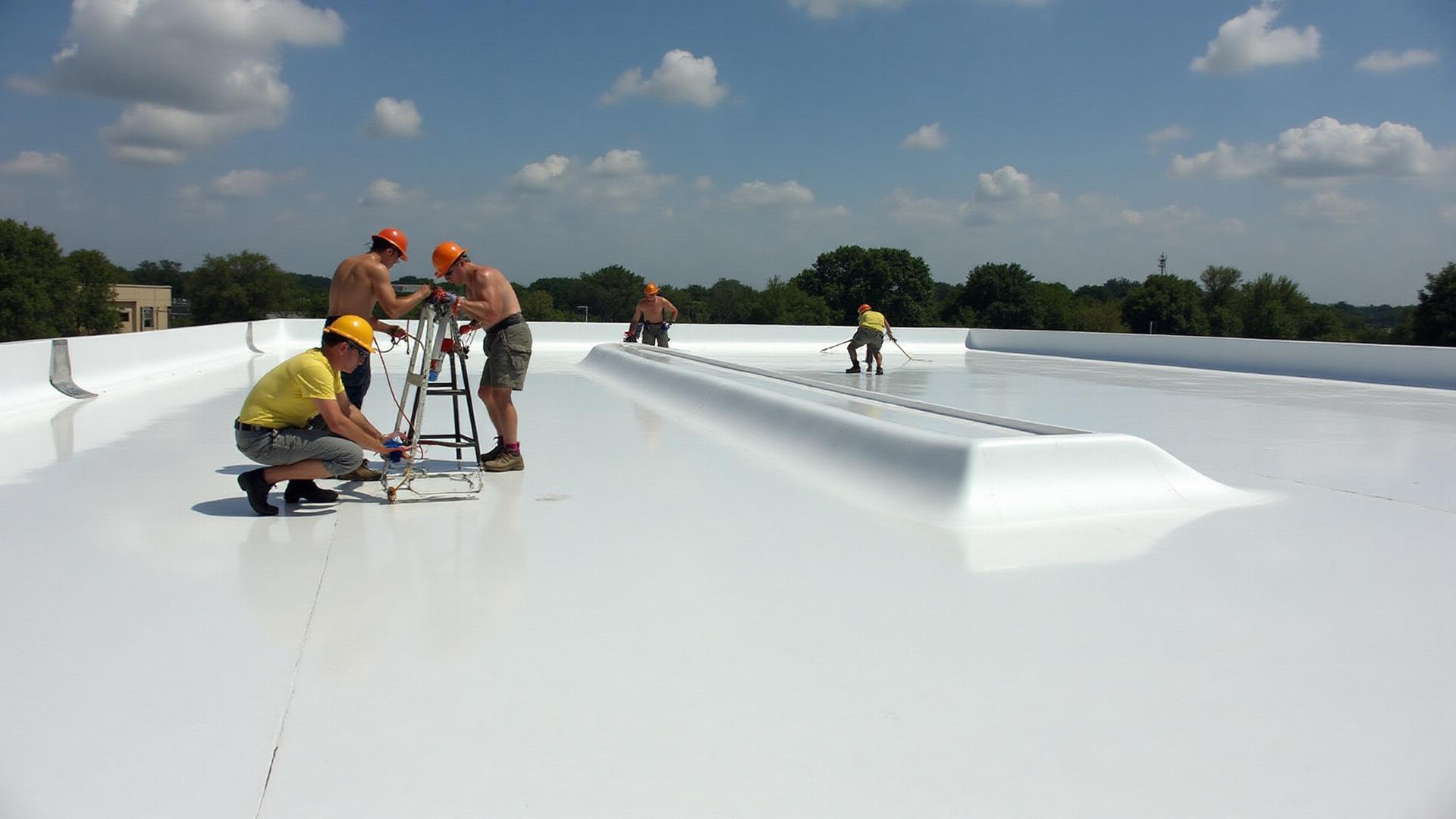
Not every roof surface belongs beneath an array for twenty-five years. We lean toward a thicker reflective single-ply, typically a 60-mil TPO or PVC, for two reasons. The reflectivity keeps the assembly cooler under the modules, which matters when the roof deck is baking through an Inland Empire summer. The added thickness shrugs off the foot traffic that comes with panel washing and inverter service, the kind of repeated wear that chews through a thin sheet at exactly the spots crews keep stepping. PVC and KEE membranes also resist the plasticizer migration you can get where some rack components sit against the surface, which is the difference between a clean install and a chemical problem at year twelve.
What We Engineer For on a Riverside Solar Roof
- Membrane type and condition confirmed by core cut before any array is designed
- Trapped-moisture survey so panels never get set over wet insulation
- Honest recover, replace, or mount-as-is call based on remaining service life
- Manufacturer-approved flashing on every post, standoff, conduit run, and equipment curb
- Structural review of ballast dead load with the project engineer
- Reflective 60-mil single-ply specified where the assembly needs to run cool and take traffic
Wind Is the Quiet Risk Nobody Prices In
Riverside sits at the downwind end of the passes that funnel Santa Ana winds out of the high desert, and a field of solar panels is essentially a parking lot of small wings. Every module wants to lift, and the corners and perimeter rows want to lift hardest. The racking layout, the setbacks at the edges and corners, and the ballast or attachment density all have to be designed to the wind loads that current code assigns this zone, not to a generic flat-roof assumption. We confirm those numbers and then make sure the roof's own edge metal and perimeter securement are rated to match, because an array that holds while the edge metal peels off the building has not actually survived the wind event.
Two Contractors, Two Warranties, One Intact Roof
The fastest way an owner loses roof coverage is letting a solar crew put hundreds of fasteners through a warranted membrane while the manufacturer never sees the work. The major membrane manufacturers will keep a warranty in force over a PV array, but only when the attachment details, walkway protection, and penetration flashings meet their published solar requirements and their field representative reviews the install. We run that review as part of the project, document every detail with photographs, and get the inspection on record so the membrane warranty actually survives the array sitting on it.
We hold a pre-construction meeting with the solar EPC to lock the sequence, the conduit routing, and who is responsible for flashing what. The roof and all of its penetration details go in and get inspected before racking is set. The solar contractor warranties the power production and the electrical scope; we warranty the roof and the watertightness of everything that passes through it. You end up with two clean warranties instead of two trades pointing fingers at each other the first time water shows up on the floor.
Questions Riverside Owners Ask Us About Solar
Do we need to reroof before the panels go on?
Only if the roof tells us so. We core the roof and scan it for moisture, then estimate remaining service life. Fifteen-plus good years usually means you can mount as-is. Single-digit years means reroofing now is almost always cheaper than detaching and resetting the whole array later to fix the membrane underneath it.
Can we avoid putting holes in the roof?
Sometimes. Ballasted racking holds the array down with weighted pavers and skips most penetrations, but it adds dead load your structure has to carry, which is a real constraint on older tilt-up and bar-joist buildings here. Mechanically attached systems penetrate at every post, and we flash each one to the manufacturer's detail. Your structure and this zone's wind loads decide which approach fits.
Will the solar install void our roof warranty?
Not if it is done right. The major manufacturers keep warranties in force over PV when the attachment, walkways, and flashings meet their solar requirements and their representative reviews the work. We manage that review and document it, so your coverage stays intact instead of quietly lapsing the day the first fastener goes in.
What membrane do you put under an array?
For most Riverside commercial roofs, a 60-mil reflective TPO or PVC. The reflectivity keeps the deck cooler under the panels and the thickness handles the foot traffic from cleaning and service. Where the structure rules out ballast, we go fully adhered with engineered attachment.
Do you sell or install the solar system itself?
No. We are the roofing half of the job. We confirm the roof is a good candidate, prepare and protect it, flash every penetration, and coordinate with whichever solar contractor you choose so the two scopes and the two warranties line up cleanly.