Riverside sits close enough to the San Gorgonio and Banning Pass wind corridor that Santa Ana events reach commercial roofs here with real force: this is not the kind of breeze that only rattles a sign. When those winds funnel down out of the mountains and accelerate through the pass before spreading across the Inland Empire, low-slope commercial membranes take the load first: at the edges, the corners, and anywhere a seam or fastener pattern is already weak. Winter brings a different peril: slower-moving Pacific storm systems and occasional atmospheric river events that dump sustained rain on roofs built for a mostly dry climate. Both perils generate claims, and each one needs to be documented on its own terms.
How Santa Ana Wind Damage Actually Shows Up on a Roof
Wind claims rarely start with a hole. They start with uplift: a membrane edge that lifted and re-seated, a seam that opened slightly, or coping and edge metal that shifted just enough to break the seal underneath. From the ground, none of that looks like damage. On the roof, it shows up as displaced fasteners, stressed or torn membrane at parapet corners, bent or missing edge metal, and rooftop equipment that shifted on its curb. We map every one of those conditions across the full roof rather than only the section visible from a ladder, because Santa Ana events load corners and edges unevenly.
What a Winter Storm Claim Looks Like
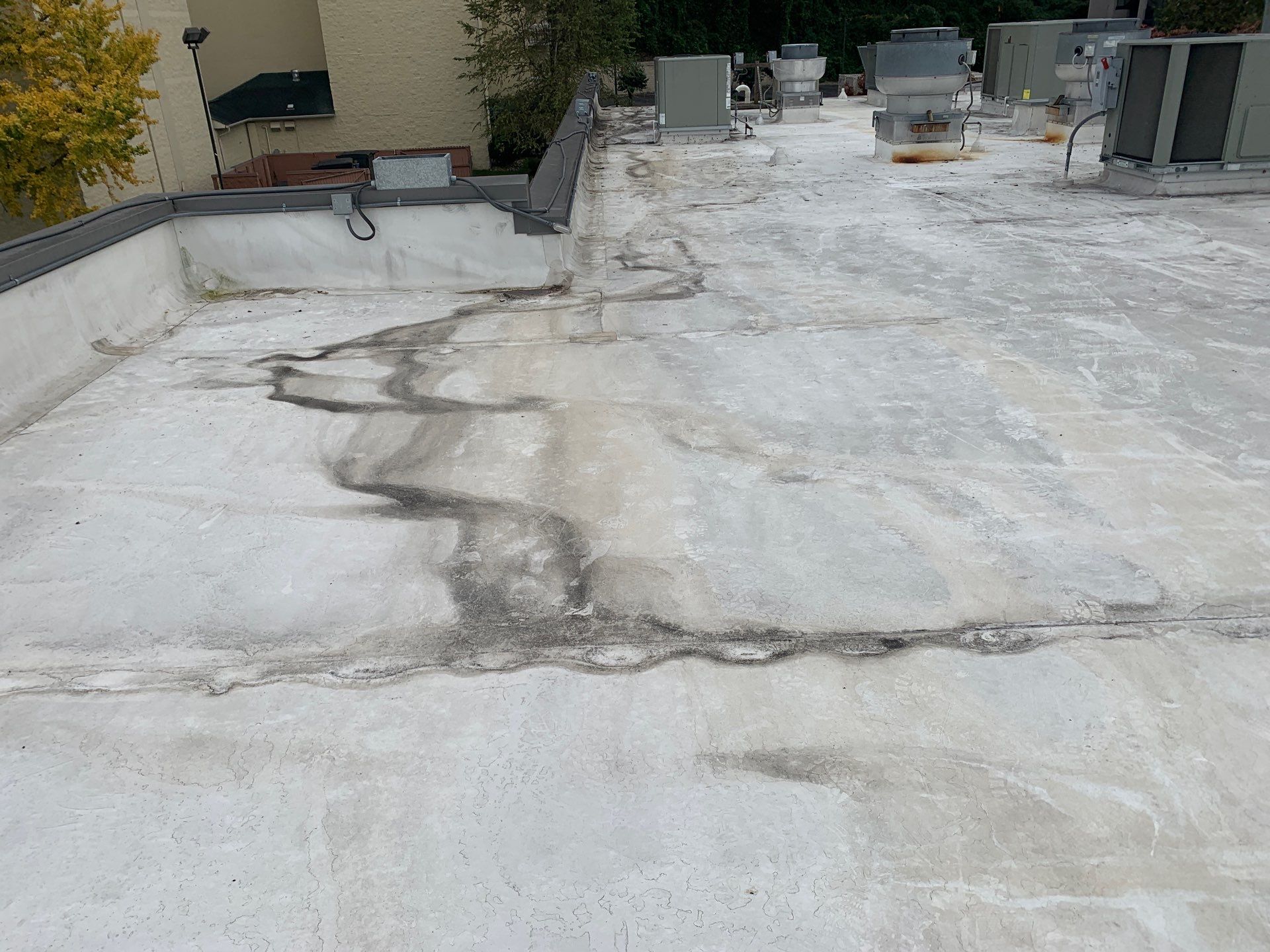
Riverside's winter storms are a different documentation problem. Sustained rain finds every existing weakness: a seam that was fine in dry weather, a drain that was already slow, a penetration that was never quite sealed. Instead of one dramatic point of failure, a storm claim usually involves multiple smaller entry points and interior water tracking that doesn't line up neatly with the roof location above it. Moisture surveys matter more here than photos alone, since wet insulation can sit hidden under a membrane that still looks intact from the surface.
Documenting Uplift and Water Intrusion for the Adjuster
Our inspection after a wind or storm event covers the whole field: parapet corners, roof edges, coping and gutter lines, drains and scuppers, rooftop curbs, penetration flashing, and any area with a documented leak history. We photograph and measure the damaged sections, take moisture readings where saturation is suspected, and note whether the roof's overall condition and age are consistent with wind-related failure or with pre-existing wear. That distinction matters to a carrier evaluating cause of loss, and we lay it out factually rather than arguing a position.
Meeting the Adjuster on a Wind or Storm Claim
When the adjuster comes out, we walk the roof with them and point to the specific conditions in our documentation: the corner where uplift started, the seam that separated, the drain that backed up and caused ponding. We answer questions about the membrane type, the roof's age and prior repair history, and how the specific damage pattern lines up with the wind speeds or rainfall reported for that event. We don't push a settlement figure; our job is making sure the adjuster sees an accurate, complete picture of the roof.
Framing the Full Repair Scope After a Wind or Storm Event
A wind or storm claim that only covers the most visible tear often misses the surrounding conditions that caused it. If edge securement failed in one corner, the same fastening pattern is usually present around the rest of the perimeter and due for the same fix. If a drain backed up and caused ponding, the scope should address the drainage issue itself, rather than only the membrane patch above it. We itemize that connected scope, including any code-required upgrades to drainage or edge detailing, so the claim reflects what the roof actually needs beyond the point of visible failure.
Warehouse and Industrial Roofs Carry More Wind Exposure
The Inland Empire's concentration of large-format warehouse and distribution roofs along the 215, 60, and 91 corridors means more square footage of low-slope membrane exposed to wind uplift than most metro areas see. Bigger roof fields mean more perimeter length, more penetrations for HVAC and rooftop equipment, and more opportunity for a Santa Ana event to find a weak point. Extreme summer heat ages TPO seams and adhesives between storm seasons, which is part of why a roof that held up through prior wind events can still fail in the next one: the membrane's condition changes even when nothing visibly happens in between.
Getting a wind or storm inspection scheduled soon after an event, rather than waiting for a leak to show up inside, is what keeps a claim file accurate. Damage from Santa Ana winds or winter rain across Riverside, Moreno Valley, Corona, Jurupa Valley, Ontario, Fontana, San Bernardino, Redlands, Perris, and Temecula tends to compound between storms: a lifted seam widens with the next wind cycle, and standing water finds a new low point after each rain. We're your roofing contractor, not a public adjuster: we document and substantiate the wind and storm damage so you and your adjuster are working from an accurate, current scope.